
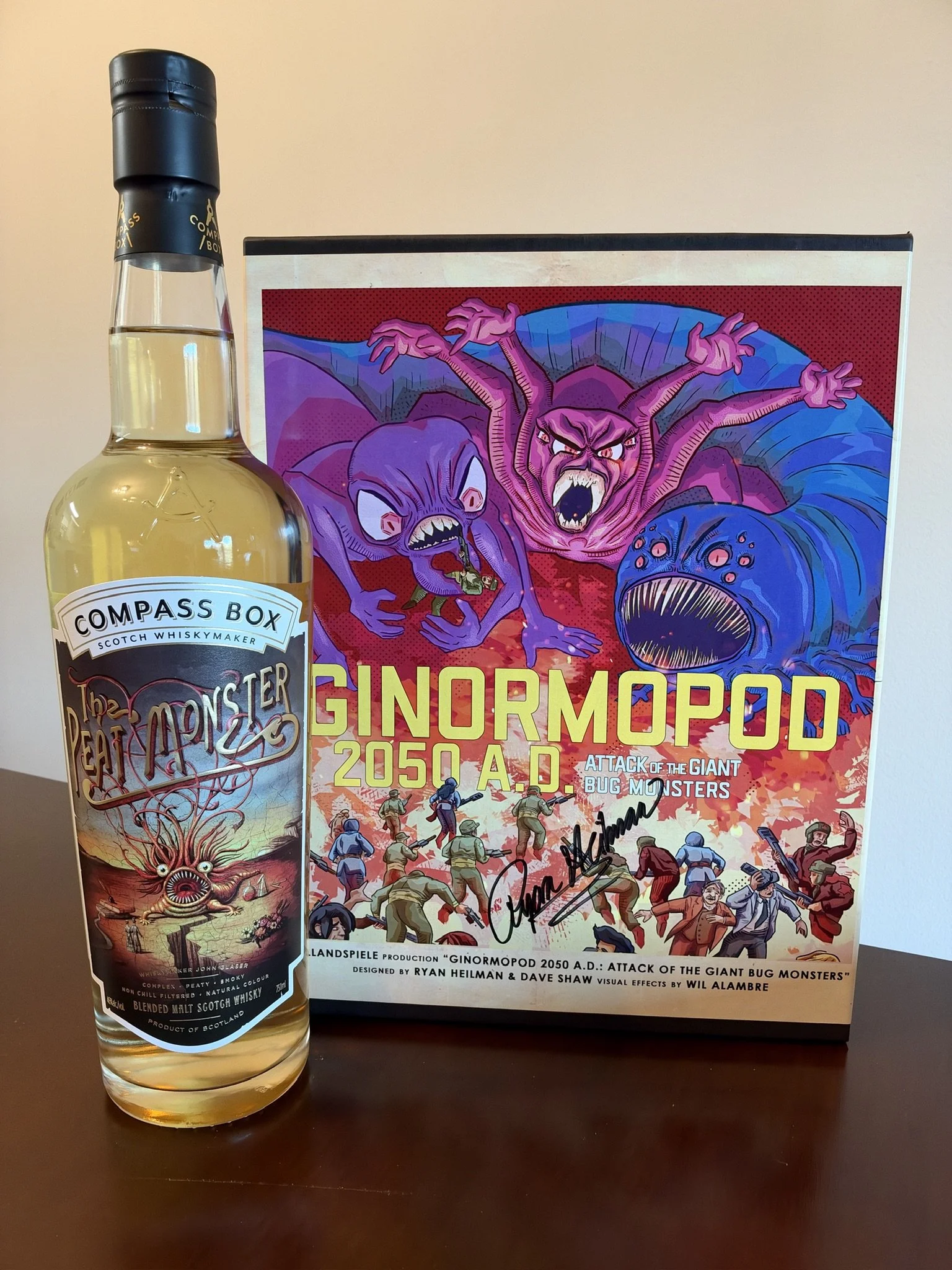
What else could we possibly pair with this masterpiece? Photo © 2026 WargamesandWhisky.com
In a World…
Remember those posters for sci-fi and horror B-Movies? A nervous-looking scientist, a noble chisel-jawed soldier charging into the flames of a city under attack by giant ants? Or maybe spiders? Or maybe giant space slugs! Ginormopod 2050 A.D.: Attack of the Giant Bug Monsters is everything those movie posters promised, rendered lovingly in a tower-defense style wargame designed by Ryan Heilmann and David Shaw, with truly amazing B-movie artwork by Wil Alambre. It’s little wonder that this gem is published by our favorite indie publisher Hollandspiele, but sadly it left their catalogue in November 2025 - though it’s still available on sites like Noble Knight. (Note: we earn a small commission from our affiliate link at no additional cost to you.)
Fade In: The Year 2050 A.D.
The world of Ginormopod isn’t a gritty, realistic, or even shiny-clean future vision of the year 2050 - it’s the 2050 as mid-century Hollywood movie poster artists imagined it: campy, larger-than-life monsters leaving humanity’s only hope in the hands of the same science that created the mutant menaces in the first place. The only thing slowing the endless tide of giant mutant bugs and insects is the Fusion Fence along the Mississippi River, and the remaining armed forces of the United States and its surviving allies. Humanity must hold out until the final round, when its scientists can develop the anit-mutagen needed to shrink the giant bugs back down to size. The Swarm must relentlessly slither across the United States until Washington, D.C., New York, and Atlanta fall to their advance.
How it Plays:
Each player takes opposing roles in this cult classic scenario: Humanity, represented by America and its allies, or The Swarm and its endless supply of spiders, worms, ants and other supersized mutant bugs. Each side is broken down into different groupings - A, B, C, and D for the Americans, and alien glyphs for the swarm. Both sides have activation markers thrown in a cup or bag, and drawn one at a time creating uncertainty as to not only when a player will take their turn, but what parts of a player’s army (or slimy horde) will take their action. This leads to possibilities ranging from alternating every single pull from the cup, all the way to one side taking an entire turn’s worth of actions before their opponent has even gotten a chance to respond. Of course, the latter event is a double edged sword, since the second player will get a chance to act without the first being able to react and pivot. The designers aren’t the first to use this method of turn order in a wargame, but it feels streamlined here even as breaking down each side’s units into different activating groups adds complexity through possible combinations of alternating initiative.
Our favorite mechanic in Ginormopod, however, is the apocalypse. Yes, there is an apocalypse mechanic! Both humanity and the giant mutant bugs have access to incredibly potent weapons of mass destruction… but with each use, the odds of the world ending at the end of the turn increase. If you are the one to shatter the Earth and trigger the apocalypse, you lose! Yes, even if you are playing as giant bug monsters, the game takes a dim view of upsetting Earth’s ecological balance through doomsday earthquakes. As the chits are pulled, the swarm is respawned, and humanity’s hold on the Fusion Fence grows increasingly more tenuous, those WMDs look more and more tempting - either to desperately buy precious time, or finish off the last of humanity’s defenders and clear the path to the East Coast.
Fade to Black
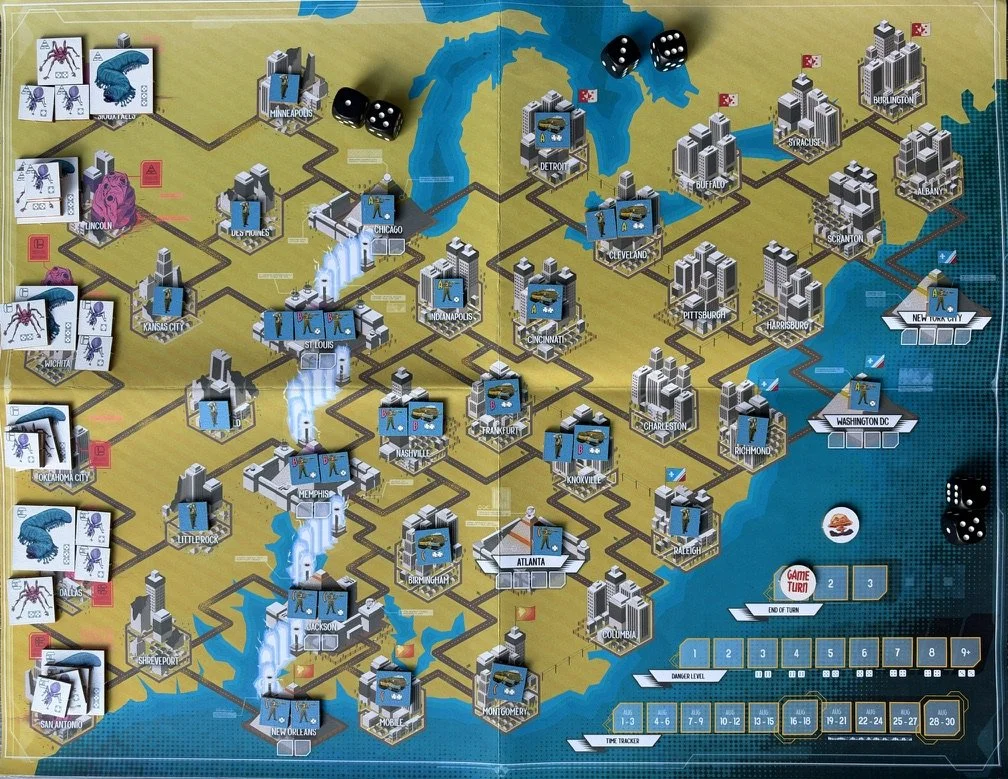
The West Coast has fallen. Raise a glass of The Peat Monster and ready yourself for humanity’s last stand. Photo © 2026 WargamesandWhisky.com
Just look at the bottle. The Peat Monster is the only choice here. For those who aren’t familiar with Compass Box, they are a blender, and not a distiller. That means each bottle of Compass Box contains names you’re likely familiar with, in percentages masterfully apportioned by John Glaser. In this case, it’s 65% Caol Ila and 35% Laphroaig single malts- a real peat monster of a mash-up. Caol Ila, of course, is a ginormous distillery. Located on a gorgeous bay on Islay, the distillery produces nearly 6.5 million liters of spirits annually. Laphroaig, on the other hand, with its 3.5 million liters, on no less a beautiful Islay bay of its own, is a distant second, but in this blend, the signature Laphroaig peat smoke truly shines. It’s joined by briny sea spray hints, warm vanilla notes, and a spiced crisp apple goodness. With its long finish, it’s the perfect dram to see your through the victory over the ginormopods, or the end of the world as we know it.