Embrace the News: 1979- Revolution in Iran
Speaking of wars without end, our third entry in this series takes a cue from the on-again off-again conflict with Iran. Miss the last pairing? Find it here.
While the US and Iran work on defining their…particular relationship, we recommend reliving another disruptive moment in US-Iran history that has echoes in today’s conflict: the revolution that brought the IRGC to power.

The current Iran War exploded onto the world in the winter of 2026, but has its roots in the foundation of the Islamic Republic itself - an event inescapably intertwined with the United States in ways that would shape the trajectory of the Middle East. For a wargame-level examination of the Iranian Revolution, we recommend 1979: Revolution in Iran, designed by Dan Bullock. (Note: we earn a small commission from our affiliate link at no cost to you)
The game opens in 1953 as a coalition of workers, reformers, students, and Islamic clerics seek to nationalize Iran’s oil as a means to weaken the Shah’s autocratic, and generally pro-western, regime. Played over several rounds, two distinct eras, and 26 years of history, 1979: Revolution in Iran pits the Coalition against the Sha’s Royalist forces through a Card-Driven system that provides the ‘Ops. or Event’ engine common in the wargaming genre. The cool, knife-twist innovation Bullock designed is that each player’s hand of cards is drafted before the round begins, meaning that you have knowledge of your opponent’s hand and the inevitable chaos they can wreak on your plans. The only question is, what will you do about it? What can you do?
The Shah must control the board and suppress the Coalition’s support long enough to build enough of its own wealth - represented by vast estates the Royalist player squirrels away - before the monarchy falls. The tools at the Shah’s disposal are loyal Royalists with dwindling influence in the government… as well as the not-so-covert assistance from the CIA and MI6. These foreign assets are essential for the Shah to remain in power, but the second knife-twist in the game’s design is that as powerful as these resources are, they will accumulate negative victory points for the Royalist player at the end of the game. In contrast, the Coalition must organize mass demonstrations and oil worker strikes to defy the Royalists and build popular support for the nationalization and takeover of Iran’s oil wealth, which, during the time of the game, is firmly and disproportionately controlled, meted, and hoarded by the British. If the Coalition has enough support, they can - and will - force an early revolution that ushers the Islamic Republic into power.
For a pairing, what could be more appropriate than Johnnie Walker Black Label, a scotch smuggled through black markets since the Iranian regime came to power, and popular at underground parties thrown by anti-regime youth.
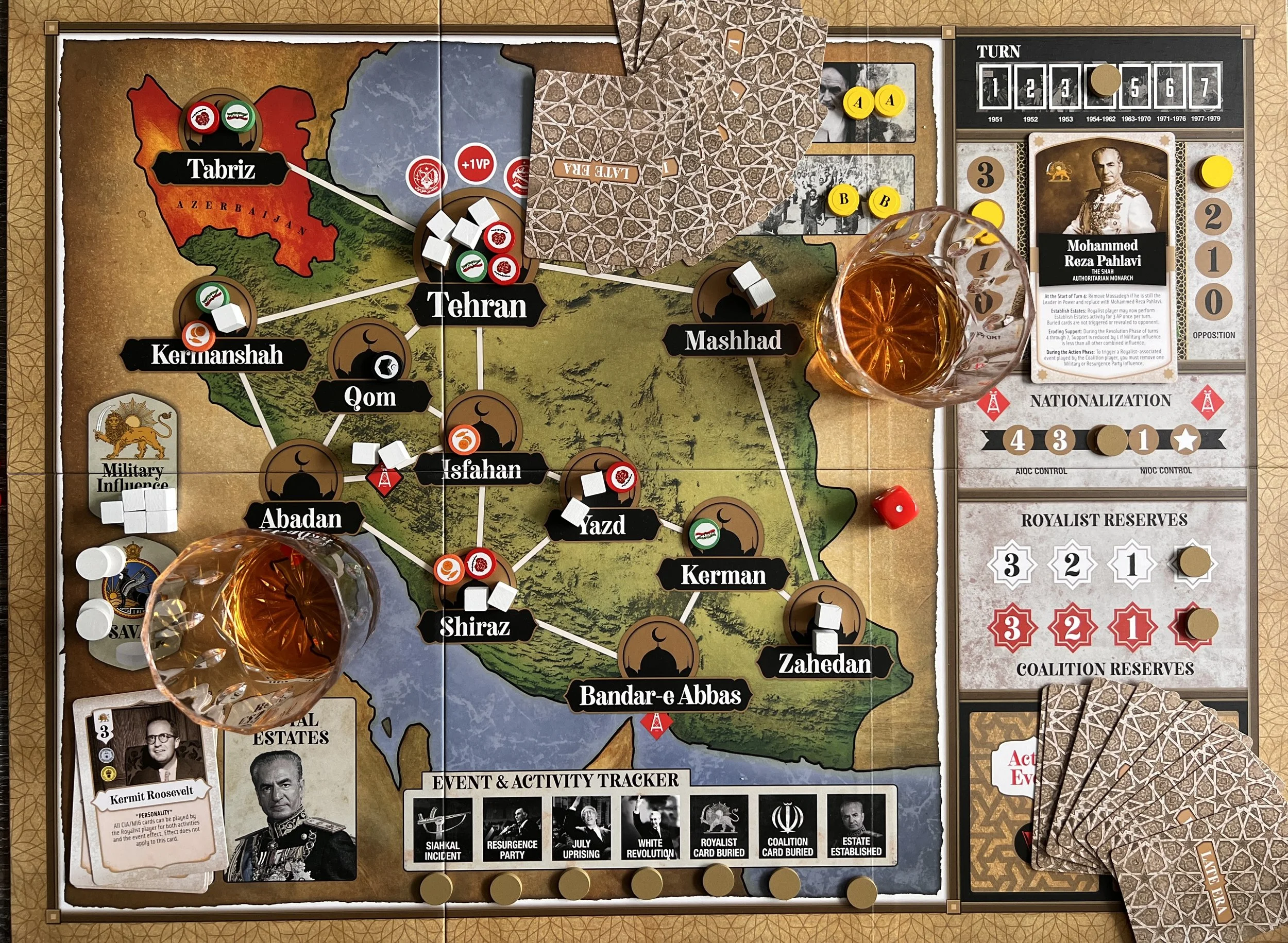
Midway through the game, it’s starting to get crowded in Tehran… Photo © 2026 WargamesandWhisky.com
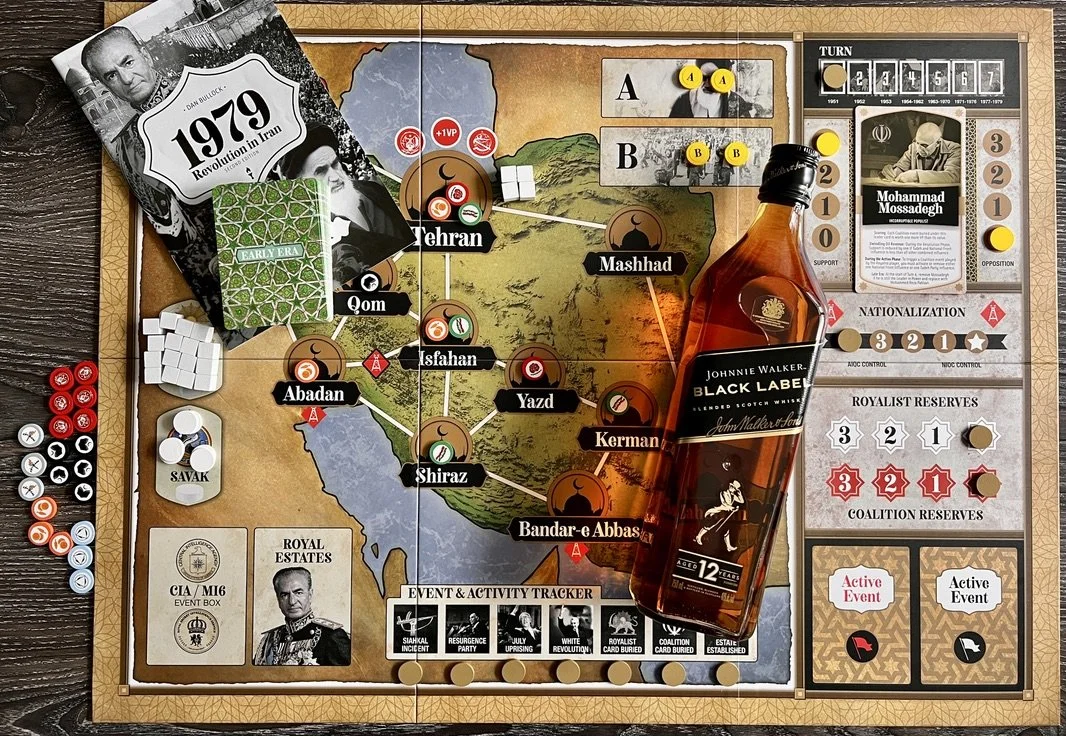
Johnnie Walker Black Label even matches the board. Photo © 2026 WargamesandWhisky.com
Johnnie Walker is ubiquitous in many parts of the Middle East. The origins of how this came to be are a history lesson in the spread of British culture during the late colonial era, when imported Scotch became the ultimate luxury symbol, showcasing the drinker’s prestige. Even now, it’s used to barter, negotiate deals, and graciously thank hosts. When considering a pairing for 1979, we also gravitated toward Johnnie Walker Black Label, because it’s a 12 year blend that’s got a little bit of everything, much like the current conflict. Fruits from the autumnal orchard? Check. Dark cocoa? You got it. Vanilla? A little. Smoke? Maybe a hint, like a Lacroix seltzer. This is the kind of blend you imagine gets made by a committee, a disparate grouping with special interests each their own, coming together to make something happen. The most surprising thing? This whiskey packs a bite, which is generally unexpected for a 12 year.