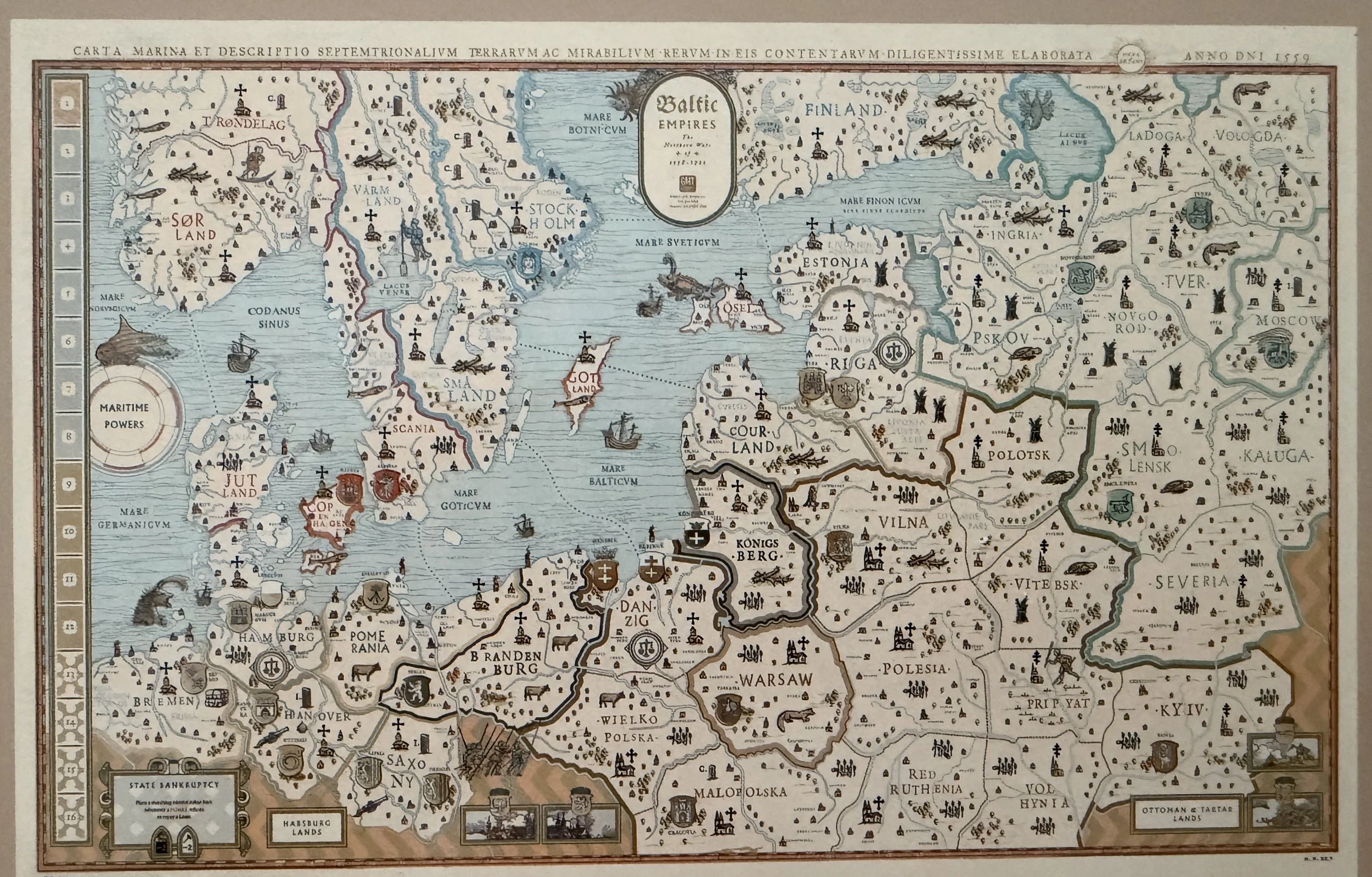
We don’t think we’ve ever seen a wargame set specifically and exclusively within the history of the Baltics - until now. Baltic Empires: The Northern Wars of 1558-1721 was designed by Brian Asklev, and steps into this void, using 163 years of dramatic history as the backdrop for a wargame sweeping in its narrative but light on its learning curve. (Note: we earn a small commission from our affiliate links at no additional cost to you)
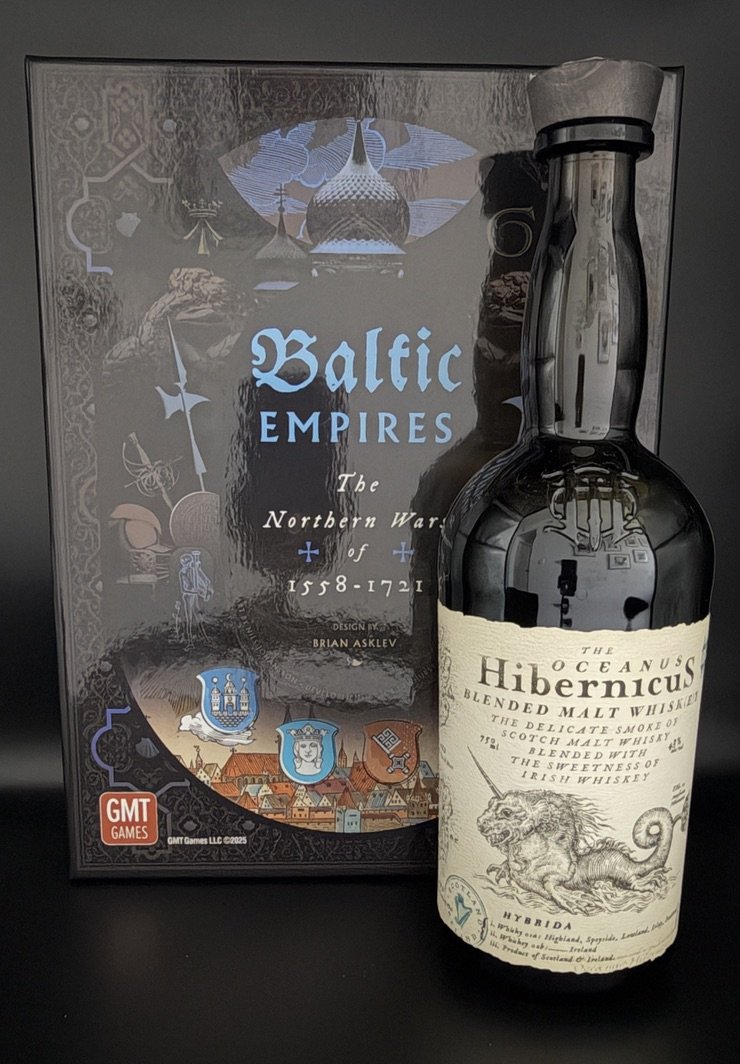
Here there be narwhals! Photo © 2026 WargamesandWhisky.com
Two-to-five players choose one of the great Baltic powers of the era: Denmark-Norway, Sweden, Russia, Poland-Lituania, or Brandenburg-Prussia. Each nation has a different composition of available units, a unique and geographically-constrained economic potential, and specific territorial ambitions that overlap with each other and drive intense competition. As players deploy their military, increase their resources, and spread their economic influence they track their positions relative to their rivals on the Hegemony Tracks: Military, Production, and Mercantile. The leader on each track becomes the Hegemon of that measure of national power, and earn the ability to determine turn order at critical moments in gameplay, breaking ties in certain circumstances, or receiving additional resources. Victory is achieved by becoming Hegemon of all three tracks, no small feat if your opponents are paying attention!
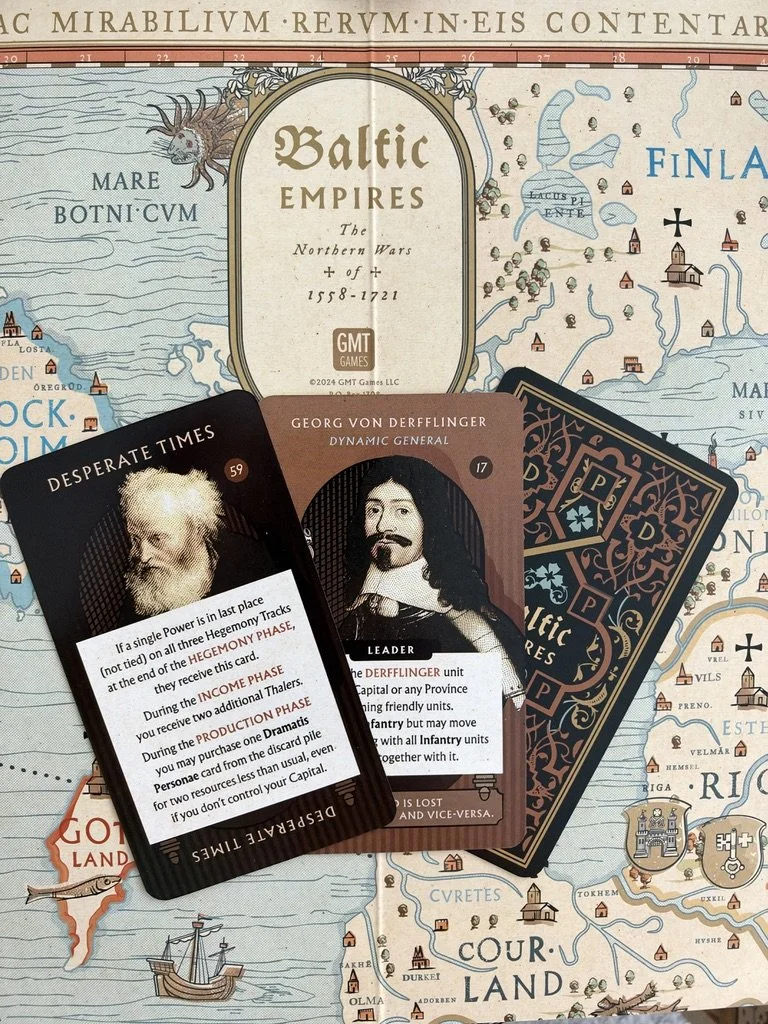
Dramatis Personae cards bring the drama for sure- these are very powerful cards that can hobble opponents - leaving them to fall into Desperate Times. Photo © 2026 WargamesandWhisky.com
Powering the game mechanically is an economic system of harvested resources, the efficiency of which depends on whether you have asserted centralized royal control over your territory or allowed political authority to devolve to your loyal nobles at the provincial level. Letting the nobles run the frontiers of your empire is cheaper, but they will skim off the top of whatever riches your infrastructure could collect. This is no small thing, as sets of different resources are used to acquire any and everything in Baltic Empires, from levying new troops to tempting historical personalities into your personal court. Your cities will of course yield up valuable taxes in the form of cold, hard, currency, but the resources from your frontier will always be more plentiful. Also on offer are Dramatis Personae cards, available for purchase each round. They introduce powerful abilities - whether one-time use or persistent effects - that can hyper charge an already promising strategy or knee-cap your opponents.
The combat system in Baltic Empires is also worth mentioning. Unlike many deep historical simulation games, Baltic Empires opts for custom dice for each type of unit, with combat lasting for only one throw. Left with enemy pieces in the same territory after that round of combat? No problem - well, except for the part where the two armies will pillage the countryside and remove resource production from the board. And to actually take control of enemy territory? That’s even trickier, since you need a full round of undisturbed control to switch ownership of a province through military means. This complication - time mixed with combat rounds that could devastate the whole map - dovetails into what is our favorite mechanical innovation from Baltic Empires: there are only two things players can exchange as part of negotiations. The first is coins, which is pretty standard as far as these games go. The second, however, is territory itself. Many games offer the ability to negotiate with other players, formally or informally agreeing to withdraw from one space if your opponent withdraws from another. Baltic Empires may be the first game we’ve encountered that provides a mechanic that allows players to directly swap control over spaces on the map. It is a mechanic we took advantage of a lot more than we anticipated, as open war proved a quagmire of blood and treasure.
If you’ve been curious about wargaming but hesitant in the face of deep simulation-based design with dozens of pages of rules, Baltic Empires is hard to beat as an entry into the genre that sacrifices none of its depth with a set of rules that are intuitive, and an open negotiation space that brings a unique story to each game.
Baltic Empires is a game of negotiated alliances- the sides working to achieve their imperial goals, but negotiating and cooperating when mutually beneficial. The same can be said for The Oceanus Hibernicus- a uniquely hybrid whiskey that brings together a combination of single malts from four distinct regions of Scotland (Highlands, Lowlands, Speyside, and Islay) with a single malt Irish whiskey. The blend’s nose is alluring- sophisticated and inviting. The palate is on the thinner side- none of the components eclipse the others, but rather meld into a union of complimentary flavors- sweet, fruity, and malty. The finish lets the light peat smoke linger, much like the smoke that slowly dissipates over a battlefield after a mighty clash of empires.